Snow Day Predictor ❄️ Snow Day Calculator & Chance of Snow Day Tomorrow
Find out the probability of a snow day tomorrow using real-time weather forecasts and historical school closure patterns.
Our Snow Day Predictor and Snow Day Calculator analyze snowfall, temperature, storm timing, road conditions, and regional school policies to estimate the likelihood of a school closure and percentage chance of school closures in your area.
Check the Chance of a Snow Day in Your Area
Wondering “Will tomorrow be a snow day?”
Enter your city or ZIP code to check the snow day odds in your area and see whether tomorrow is likely to be a snow day, delay, or regular school day.
Enter your location to check the snow day chances instantly.
Snow Day Predictor & Snow Day Calculator
The Snow Day Predictor analyzes upcoming winter weather conditions and estimates the likelihood of a school closure based on real-world decision factors. In practice, the tool functions as a school closure predictor, estimating how likely districts are to cancel classes during winter storms.
Unlike simple snowfall calculators, the system evaluates multiple variables including snowfall accumulation, temperature, freezing rain risk, storm timing, and historical school closure behavior.
Will There Be a Snow Day Tomorrow?
Every winter, students, parents, and teachers ask the same question: Will tomorrow be a snow day?
While no system can guarantee school closures, the Snow Day Predictor estimates the probability of a snow day tomorrow using real-time weather forecasts and historical closure trends. Many families check the snow day forecast the night before and again early in the morning as updated weather data becomes available.
By analyzing snowfall, temperature, storm timing, road safety, and regional school policies, the predictor provides a realistic estimate of whether schools in your area may close due to winter weather.
Is Tomorrow a Snow Day?
Many people search for a simple answer: Is tomorrow a snow day?
While no predictor can guarantee school closures, the Snow Day Predictor analyzes forecast snowfall, temperature, storm timing, and road safety conditions to estimate how likely schools are to close in your area.
Checking the prediction the night before and again in the early morning helps families stay informed as the snow day forecast updates.
Snow Day Odds and Likelihood
Many people search for the odds of a snow day tomorrow or the likelihood of a school closure.
The Snow Day Predictor calculates these odds by combining real-time weather forecasts with historical school closure data. Instead of guessing based on snowfall alone, the system evaluates multiple winter weather factors to estimate how likely schools are to close in your area.
This approach provides a more realistic snow day probability than simple snowfall estimates.
Understanding Your Snow Day Percentage
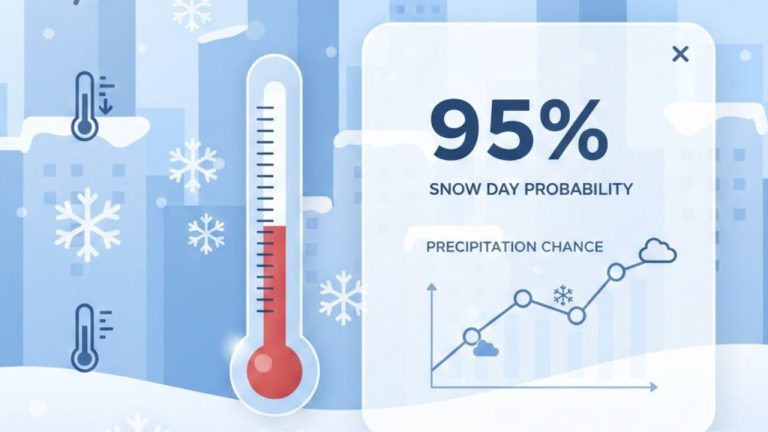
The Snow Day Predictor displays results as a percentage instead of a simple yes-or-no answer.
This snow day percentage represents how likely schools in your region are to close based on forecast conditions and historical closure patterns.
Typical interpretation:
- 0-30%: Schools are very likely to remain open.
- 30-60%: Conditions could lead to delays or early morning decisions.
- 60-80%: Closures become increasingly likely.
- 80-100%: Historical patterns strongly suggest schools may close.
This probability-based approach helps families prepare for multiple outcomes instead of relying on uncertainty.
Chance of a Snow Day Tomorrow
What Are the Chances of a Snow Day Tomorrow?
Many people search for questions like:
- What are the chances of a snow day tomorrow?
- What is the probability of a snow day tomorrow?
- What are the odds of school being closed tomorrow?
The chance of a snow day depends on several factors, including snowfall accumulation, storm timing, road conditions, and school district policies.
Heavy snowfall overnight may not close schools if roads can be cleared before buses run. However, ice, freezing rain, or rapid snowfall during the morning commute can significantly increase the likelihood of closures.
The Snow Day Predictor analyzes these variables to estimate the probability of school closures for tomorrow in your specific location.
How the Snow Day Predictor Works
The Snow Day Predictor evaluates several weather and safety factors that influence school closure decisions.
These include:
- Snowfall accumulation: Expected snowfall totals and rate of accumulation.
- Storm timing: Whether snow arrives overnight, during the morning commute, or after school hours.
- Temperature and wind chill: Extreme cold can affect safety for students waiting outdoors.
- Ice and freezing rain: Even small amounts of ice can create dangerous travel conditions.
- Regional snow readiness: Northern regions often handle snow more efficiently than southern areas.
By combining these factors, the system generates a realistic snow day probability rather than relying on a single snowfall threshold.
How Much Snow Is Needed for a Snow Day?
One of the most common questions people search for is:
How many inches of snow cause a snow day?
The answer depends heavily on location.
- In southern regions, just 2-4 inches of snow may close schools because snow removal infrastructure is limited.
- In northern areas like the Midwest or Canada, schools often remain open even after 8-12 inches of snowfall.
Ice, freezing rain, and poor road conditions often have a greater impact on closures than snow depth alone.
Manual Snow Day Calculator
The Manual Snow Day Calculator allows you to simulate different winter weather conditions to see how they influence the likelihood of school closures.
You can adjust variables such as:
- snowfall amount
- ice accumulation
- temperature
- wind chill
- storm timing
- wind speed
This tool helps users explore “what-if” scenarios and understand how school closure decisions are made.

Where the Weather Data Comes From
The Snow Day Predictor integrates weather forecasts from trusted meteorological sources including:
- National Weather Service (NWS)
- NOAA
- Environment Canada
- Open-Meteo
- AccuWeather forecast models
Using multiple sources allows the system to cross-check forecast signals and improve reliability.
How Accurate Is a Snow Day Predictor?
A snow day predictor provides an estimate, not a guaranteed outcome.
School administrators make final decisions based on real-time road conditions, bus route safety, and local information that may not be publicly available.
However, probability-based models using real-time weather forecasts and historical closure patterns can provide useful insight into how likely a closure may be.
For the most reliable results, many users check the snow day forecast and probability the evening before a storm and again early in the morning when updated forecasts become available.
Frequently Asked Questions
What Is Snow-Day.net?
Snow-Day.net is a global snow day probability calculator designed to help students, parents, and educators understand the likelihood of school closures during winter weather events.
Instead of relying on rumors or last-minute announcements, the platform analyzes real-time weather data and historical closure patterns to estimate the chance of a snow day in any location.